Milford Faces ‘Contentious Issue’ of Extending Sewer Service
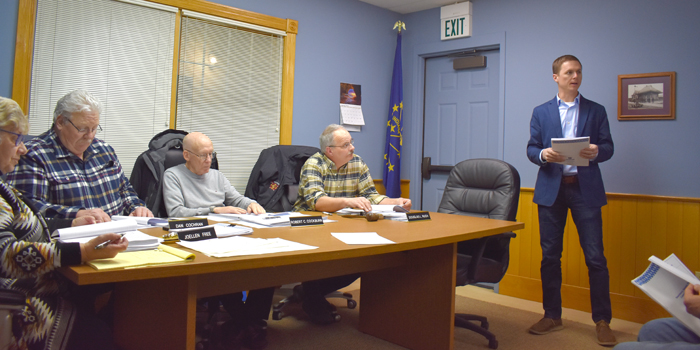

MILFORD — Milford Town Council spent the majority of its monthly public meeting Monday evening, Feb. 12, discussing the possibility of extending sewer service to Camp Alexander Mack. Also in attendance were residents from the area possibly affected, representatives from Camp Mack and Bob Weaver, administrator of the Kosciusko County Health Department.
Attention was primarily directed, however, at Ryan Brauen of Wessler Engineering, who conducted a feasibility study of the project, commissioned by the town council at a cost of $8,500.
Brauen presented the town with three options: Do nothing; install service to Camp Mack only, without the possibility of service connections for 65 properties along CR 1150N; installation of service to Camp Mack and the 65 properties — 51 connections plus 15 future connections currently undeveloped.
The study found the maximum flow of the third option would be 20,150 gallons, just 20 percent of the Milford wastewater plant’s reserve capacity.
The study also reported a $30,000 cost difference between the installation options: $350,000 for service to Camp Mack alone and $380,000 for service to all properties. The cost of the grinder stations each property would have to install was not included in the study; however, residents in surrounding sewer districts have paid from $10,000 to $14,000. The cost of a new septic system starts at roughly $5,000, but, according to Weaver, “varies a great deal” and is dependent on home size, soil type and other factors.
The difference in price is primarily due to the size of the force main pipe required to handle the sewage, 2 inches in the first case and 3 inches in the second.
Brauen stressed to residents the importance of this distinction and its future effects; residents will not be able to connect to the 2 inch force main pipe if, for example, their septic fails. “You have one shot to do it right,” he noted, because the cost of future upgrades would be significantly higher. “This is your opportunity,” said Brauen.
When asked by Council President Doug Ruch if the 3 inch pipe could allow for expansion to other areas of Waubee Lake, Brauen responded no, but later suggested the idea of researching other Waubee residents’ opinions about sewer “had merit.”
According to the report, 16 connections along the line, preferably at the Camp Mack end, would also enable the proposed low pressure system to move sewage along. Without these connections, regular flushing of the line would be required.
Ken Long, a Milford resident, asked if properties within 300 feet of the line would be required to connect anyway in the event only Camp Mack is serviced, as stated in state codes.
Weaver assured him the reality is “more complicated … we allow people to use septic until it fails.” The commissioners, Weaver added, “don’t try to strong arm people.”

As for how the council plans to pay for the project, Milford Treasurer Joellen Free said a portion of the funds would come from the riverboat fund, gambling revenue distributed around the state.
The town will also negotiate with Camp Mack. Jay Rigdon, town attorney, noted cost sharing could be written in to any agreement; however, the Camp Mack representatives were unwilling to comment on specifics at this time.
The council was also presented with a list of signatures on a questionnaire showing a majority of residents are against the project.
Council members questioned the wording, however, as the words “mandated,” were included, when, as Weaver indicated, this is not the case.
In response to the assertion sewers were important for Waubee’s water quality, a resident cited studies showing “the quality of the lake is fine.”
Milford resident Scott Mast countered “90 percent” of the lots on Waubee Lake do not have the required space to replace failed septic systems, adding such a property was a “sitting duck” without a sewer to connect to in the future. “You’re setting yourself up for disaster. They go bad. They all do.”
Ruch said the next step is to meet with residents to discuss their willingness to connect.
“We can’t just sit and watch infrastructure fall apart,” added council member Dan Cochran. “If we don’t look for growth something else is going to happen.”