Arguments Heard On Joining Murder Trials
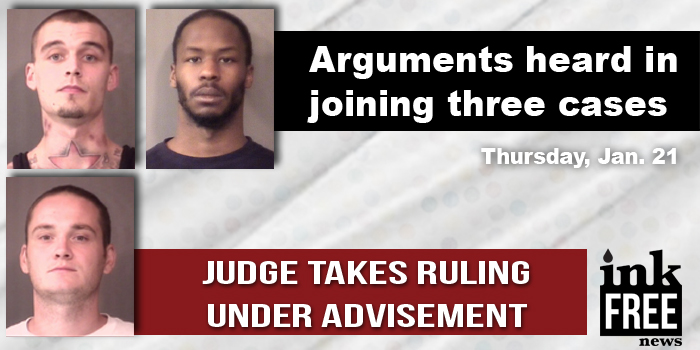
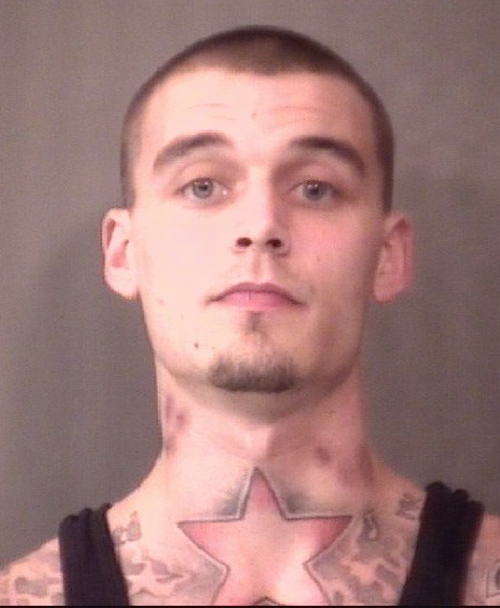
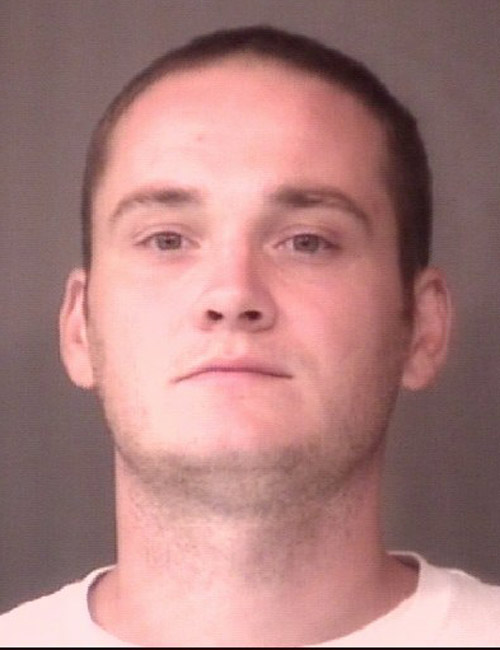
WARSAW — Arguments from the prosecution and defense attorneys on joining the trials of Brandon T. Woody, Kyle DeHart and Thomas Hursey were heard this morning, Jan. 21, in Kosciusko Circuit Court.
The three are charged with the murder of Tara Thornburg and Joshua Knisley in February 2015.
No decision was immediately made by Judge Michael Reed. All parties involved have 10 days to file briefs stating positions. Reed will then issue his ruling.
Kosciusko County Prosecuting Attorney Dan Hampton presented why he is seeking to join the three trials. He stated all three are similar in nature, have the same witnesses and no difference of evidence. Simply stated, the cases are the same. He cited a state supreme court case (502 N.E.2d 398 1987) in which it is at the trial court’s discretion to consolidate the trials.
Scott Lennox, counsel for Woody, noted the matter is more attached to the other co-defendants than his client. Lennox agrees it is at the discretion of the court to grant the joiner of defendants. He stated there is a possibility of prejudice against the other two defendants.
Larry Hansen, counsel for DeHart, argued the primary reason his client objects to the joiner is Hursey gave a voluntary statement to police implicating his client and Woody. He mentioned prejudice against his client if Hursey does not testify, along with the fact his defendant is the only non-caucasian at the defense table. Hansen brought attention to the fact other than Hursey’s statement, there has been no discovery shared placing his client at the scene.

Hansen said he is aware the only similar evidence that exists is the murder charge and Hursey’s statement. He also argued the cases should not be joined, because the cases were not filed together.
Hansen cited a U.S. Supreme Court Case Bruton v. United States 391 US 128 (1968), where the trial judge had instructed the jury that, although the co-defendant’s confession was competent evidence against him, it was inadmissible hearsay against his co-defendant. However, both received the same sentence. The U.S. Supreme Court stated because of the substantial risk that the jury, despite instruction to the contrary, looked to the incriminating extrajudicial statements in determining petitioner’s guilt. Admission of the co-defendant’s confession in the joint trial violated petitioner’s right of cross-examination secured by the Confrontation Clause of The Sixth Amendment.
Reed questioned why Hansen thought there would be prejudice because of race against DeHart. Hansen stated it is a factor, but a generalized factor, at this point in time.
Hansen stated he has the obligation to request to sever the cases, should the joiner be granted. “If you’re talking economy, all of us at this table are telling you, you may not save any time,” he said.
Garza’s objection, similar to Hansen’s, focused on the safety of his client. That statement, according to Garza, put his client in a precarious position. Reed noted the court would take care of his safety if that happens.
Brad Voelz, deputy prosecuting attorney, addressed the Bruton reference, stating the cause is important, but not now. “If we join the trials, preparations continue … The correct remedy is to move to exclude testimony and the court is justified to do so.”
Related:
- Change Of Venue Denied
- Motion Filed To Join Woody, DeHart And Hursey Trials
- Media Thrown Under The Bus By Defense In Murder Case
- Change of Venue Hearing Date Moved
- Change of Venue Hearing Reset
- Hearing Set Tuesday On Change of Venue
- Murder Trial Dates Set For Woody And DeHart
- Wheels of Justice Slow, But Moving
- Murder Trial Postponed, No Date Set
- Woody To Present Brief On Change Of Venue
- Woody Set For Five-Day Trial In August
- Alibi Defense Filed In Murder Case
- Woody Request Change of Venue
- Investigation Continues Into Syracuse Murders
- Hursey Charged As Fifth Subject Involved In Syracuse Murder
- Kyle DeHart Has Initial Hearing, To Hire Own Attorney
- Further Details Released Surrounding Murder
- Fourth Arrest Made In Syracuse Murder
- Woody Requests Bond Reduction
- Kyle DeHart Now Charged In Syracuse Murders
- New Information Released On Syracuse Shooting
- DeHart Arrested In Connection With Syracuse Shooting
- Woody Has Initial Hearing This Morning
- Motion Filed Today To Substitute Attempted Murder Charge
- Syracuse Murder Suspect Was Arrested At Gunpoint In Mishawaka
- Syracuse Shooting Victim Remembered As Big Hearted
- Neighbor Remarks On Syracuse Shooting
- Syracuse Shooting Suspect Now In Custody
- One Dead, One Critical Following Shooting In Syracuse
- Double Shooting In Syracuse