Jimmy Rayl: More Than Just A Basketball Star
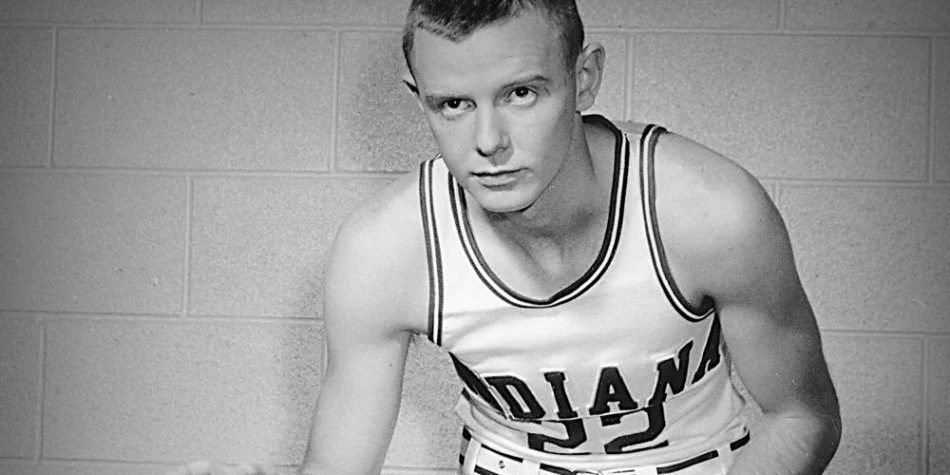

By Dean Hockney
Sport Journal of Central Indiana
KOKOMO — If anyone has ever visited the home of Jimmy Rayl, one thing is for sure – the discussion will probably start and end with sports – particularly basketball. That should not shock anyone considering his 1959 Indiana Mr. Basketball jersey and a 56-point game ball from Indiana University are prominently displayed on the wall behind the Splendid Splinter’s recliner.
No, it is hard not to talk about basketball while sitting in the Rayl family living room. But for one occasion, with prompting from his wife Nancy and oldest son Jimbo, the Indiana Basketball Hall of Famer briefly and quietly talked about his athletic career outside of hoops. Yes, the sharpest-shooter in Kokomo history is not a one- dimensional player. In fact, he was pretty darn good in nearly anything he played. Take baseball, for instance.
“I wouldn’t say I was a great player,” said Rayl. “I liked baseball a lot. I liked to practice.”
Rayl might be a little modest when describing his prowess on the diamond. The Chicago Cubs sent the Splinter a letter during his freshman year at Indiana University inquiring about his interest in trying out for the pro club. That letter arrived in Bloomington, via Kokomo High School and adorned with a four-cent Abraham Lincoln stamp, as he was starting his All-American hoops career.
“There has been a report sent into our office in regards to your prospective baseball ability,” scout John Streza hand -wrote in blue ink on official Cubs stationary. “If you are interested in baseball, I would appreciate very much if you could forward me a schedule so I may evaluate your ability when I’m in your area. Best of luck.”
Rayl was the starting first baseman for the Kokomo Wildkats and head coach Joe Platt, who, like Rayl, was better known for his time on the Kats basketball sideline. In the summer, when not shooting hoops, he played for manager Clarence Reel on the Kokomo Ameri-can Legion Post 6 squad in Highland Park.
“Joe Platt was the coach – and he was a pretty good baseball player too,” said the charter member of the Howard County Sports Hall of Fame. “I liked to field ground balls; I had pretty good eye- hand coordination. I rarely struck out, but my best part was fielding. I saved guys a lot of errors catching their short hops.”
Prior to his career at Kokomo, he played Little League at UCT for Mai’s Sporting Goods.
“Mai’s was located near the (Kokomo Speedway),” said Rayl of the store formerly located at 1613 N. Davis Road. “We had good times down at UCT. That was a great place to play and they had some good players.”

That means Rayl is on a list of UCT alumnus that includes professional baseball players Tom and Pat Underwood, Joe Thatcher and T.J. Weir. Of course, Rayl was a professional ballplayer him- self – with the basketball Indiana Pacers.
While he never made it to the Cubs, “I really never gave it any thought,” Rayl told a story on how he made it up to the Wrigley Field press box. Jim Enright was a Big Ten basketball official who befriended the local hoops legend during his college years at IU. Later in life, Enright was the public address announcer for the Cubs.
“About three or four of us drove up to watch the Cubs and I wrote Jim Enright a note and the usher said he would get it to him,” said Rayl. “About the fifth inning, I hear over the PA, ‘Attention! Attention! Would Jim Rayl of Kokomo, Indiana, please report to the press box!’ He said it twice. I can still hear it.
“So I went up there and my friends were waiving at me from their seats. I told him I needed to get back down to my friends, but he grabbed me by my pants and said I wasn’t going anywhere. I stayed until the game was over. He was a good guy.”
And then the legend goes right back to basketball and a story about another former Kokomo great, 1961 Indiana All-Star and state finals hero Ronnie Hughes.
“Ronnie played at Purdue, and we were playing them in Bloomington and Enright was the referee,” recalled Rayl. “There was a loose ball and I clearly knocked it out of bounds. Ronnie was right beside me, but I knocked it out. Enright said, ‘Indiana ball.’ Ronnie just looked and started laughing. What was he going to do?”
Nancy then reminds Jimmy of another sport he dominated on the local scene – handball. Turns out, he was just as hard to beat in handball as basketball – and that is saying something considering Rayl once hit 532 consecutive free throws as a junior in high school at First Congregational Church. He remembers it vividly because 32 is the number he wore as a Wildkat.
“We spent hours down in that gym,” said Rayl. “Saturday mornings we would be down there and spend most of the day.”
But what about handball?
“I was better at handball than tennis or golf,” said Rayl, who turned 75 last June. “I was a decent handball player. I still have one hand bigger – the handball is solid rubber. Hard rubber. You had to use a glove to play. We played at the Kokomo YMCA or in Peru. It was a good workout. It is a good game.”
“I used to watch him play for hours, and he would beat everyone,” said Jimbo. “He once beat the state champion of California. I remember that like it was yesterday.”
“I don’t think anyone even plays handball around here anymore,” said Rayl.
When it came to tennis, Rayl said he never developed a backhand.
“I just switched the racquet between hands, I was pretty good with my left hand,” he said. “I played a few times with David Standt, and then that was it. We grew up together. We used to play all kinds of games, like throwing the football over the power lines. Hmm, I was pretty good at drop kicking a football, too.”

And about that 56-point basketball in his living room – he actually had two 56-point games while playing for the Hoosiers, and both are still the single-game scoring record at IU. The amazing part is he did it without the benefit of the 3-point line which came along long after his playing days.
But the 56-point outing nearly didn’t happen.
“There is no question it almost didn’t happen,” Rayl said matter-of-factly, explaining that he and Indiana head coach Branch McCracken, a two- time national champion at IU, did not quite see eye-to-eye during a workout and he decided he was done with practice.
“He told me that if I left the court I would never play for IU again,” recalled Rayl, who indeed left practice. “I had a buddy who was a sports writer, and he got wind of it and was going crazy and called Branch to get me back on the team. He told me that McCracken agreed that if I went to practice and apologized to the team, I could play that Saturday. I did and they let me come back.”
That Saturday – Feb. 23, 1963 – Rayl had 32 points by halftime in his second 56-point game of his Hoosier career. The first came against Minnesota in January 1962.
“(McCracken) took me out with a minute and 20 second to go,” said Rayl. “I walked off the floor and 10,000 fans were booing. But they weren’t booing me, they were booing Branch for taking me out with 56 points – they wanted to see me break the record.”
And then, out of the blue, Rayl begins a story on how he nearly lost his eyesight as a young six- or seven-year-old. Yes, the Splendid Splinter nearly never took the court he so dearly loved.
“I was riding my push scooter on Sycamore Street and (a kid) came up behind me and pushed me off,” said Rayl. “He was older than I was and just shoved me over. I landed and cut my eye. He pulled out a dirty red handkerchief to help stop the bleeding and helped get me home. Dad took me to Dr. Hutto’s house and he stitched it up.”
Remember, this is in the early 1950s, long before today’s state-of-the-art medical equipment – back during a time when doctor’s regularly made house calls.
“A day or so later, my eye was swelling shut be- cause he didn’t get all of the infection cleaned out,” continued Rayl. “Both eyes swelled shut. We got to a doctor and they unstitched it, cleaned it and stitched it back up. It was close – I was pretty lucky coming out of that one.”
Yes, Jimmy Rayl may have played baseball and handball and tennis – he would have been good at any sport he tried – but it always comes back to basketball. And that is the way the Splinter wants it – after all, the best stories are his basketball stories. Or are they?