Tag: Indiana at 200
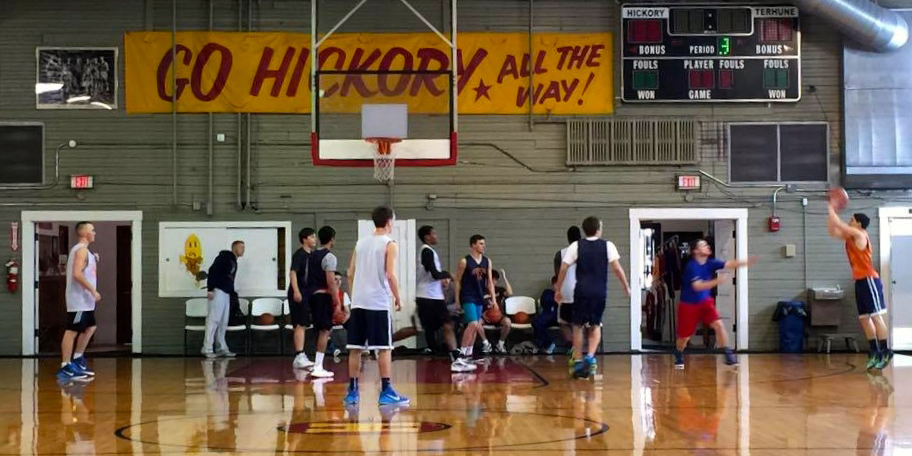
By Andrea Neal For the better part of Indiana’s history, high school basketball has been the glue that binds citizens together. Is there a Hoosier living who hasn’t played the game, cheered a sectional or seen the classic movie Hoosiers – multiple times? Or been inspired by the stories of the “mighty men of Milan” …read more.
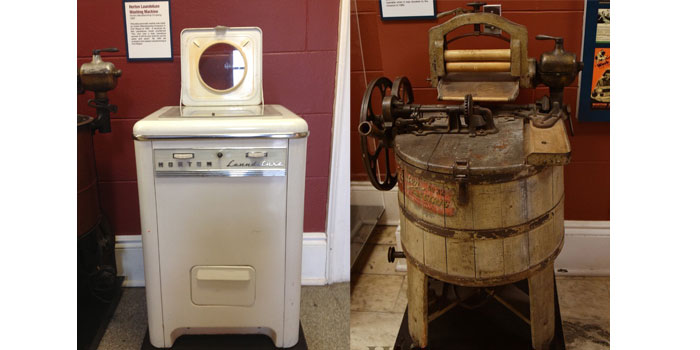
By Andrea Neal A wave of high-tech creativity in the late 19th and early 20th centuries cemented Fort Wayne’s reputation as the Silicon Valley of its day. Some innovation highlights: Jenney Arc Lights illuminated League Park in Fort Wayne in 1883 for one of the earliest baseball games played at night. A self-measuring pump mechanism, …read more.
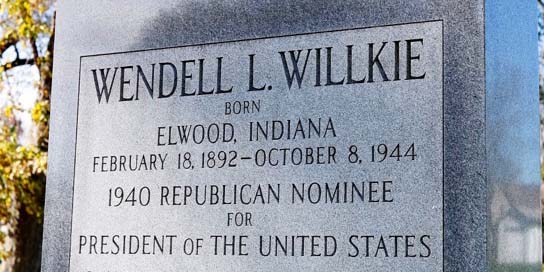
by Andrea Neal Though many might be tempted to confer the honor on Benjamin Harrison, Wendell L. Willkie is the only native Hoosier ever nominated for president by a major political party. Harrison was from North Bend, Ohio. Born and raised in Elwood, Willkie was the Republican standard bearer in 1940, securing the nomination on …read more.
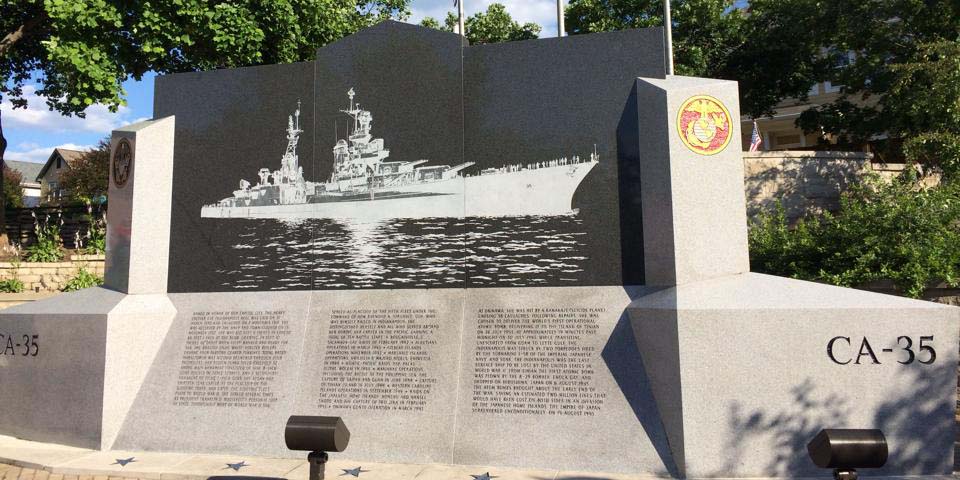
by Andrea Neal The city of Indianapolis will be forever linked to one of the worst naval disasters in history: the sinking of the USS Indianapolis in World War II. This was the 10,000-ton cruiser that delivered secret components for the atomic bomb to be used against Japan, only to be sunk by Japanese torpedoes …read more.

by Andrea Neal “Life is completely changed for thousands of American boys on this side of the earth. For at last they are in there fighting.” Hoosier war correspondent Ernie Pyle wrote those words on Dec 1, 1942, while on assignment with U.S. forces in Algiers. The United States had entered World War II in …read more.
By ANDREA NEAL If Franklin Delano Roosevelt had not run for an unprecedented third term in 1940, there is a good possibility that Hoosier Paul Vories McNutt of Franklin would have become the 33rd President of the United States. One of the most powerful politicians Indiana has ever seen, McNutt had “astonishingly good looks,” according to …read more.
by Andrea Neal Dubbed the “colored cyclone” by newspaper reporters of the early 1900s, Hoosier Marshall W. “Major” Taylor was a champion cyclist whose speed was surpassed only by railway locomotives. Despite achieving international fame — and defying bigotry and Jim Crow segregationist practices — Taylor died penniless and alone at 53, a forgotten sports …read more.

By ANDREA NEAL From his pulpit at Plymouth Congregational Church in Indianapolis, the Rev. Oscar C. McCulloch missed no opportunity to push his congregation out of the pews and into the world. “Here lies our work,” he exhorted one Sunday, unveiling a vision of a church that educated, entertained and provided role models to the …read more.

By ANDREA NEAL During the 1920s, the Ku Klux Klan took Indiana by storm. Ninety years later, Hoosiers still struggle to grasp why. The secretive brotherhood launched its Indiana recruitment efforts in Evansville in 1920. Within four years, Hoosier Klansmen numbered 250,000 and represented every corner of the state. “Members included ministers, mayors, shopkeepers and …read more.

By ANDREA NEAL The date was July 4, 1894. The location was Pumpkinvine Pike 3 miles east of Kokomo. Elwood Haynes had hauled his newfangled carriage — a horseless one no less — to the edge of the city for a test drive. He unhitched the horses that towed it there, mounted the driver’s seat …read more.
By ANDREA NEAL Although his name does not show up on lists of greatest presidents, Benjamin Harrison did more during his one term in office than some better-known presidents accomplished in two. Consider the following: He expanded the U.S. Navy to both coasts and strengthened its fleet, which had no working battleships when he took …read more.
By ANDREA NEAL In an era of declining church membership for most Christian denominations, one group of believers is experiencing healthy, unprecedented growth. In 2014, the estimated Amish population in Indiana exceeded 50,000, according to the Young Center for Anabaptist and Pietist Studies at Elizabethtown College. That’s bigger than the cities of Columbus, Jeffersonville or …read more.
By ANDREA NEAL It was Indiana’s version of the Gold Rush. In the 1880s, the discovery of a massive natural gas field in east central Indiana launched a gas boom of historic proportion. The news spread fast — as it did with California gold — and folks poured into Indiana in search of fortune. “There …read more.
By ANDREA NEAL The most poignant moments in Indiana history have taken place under its dome and on its front steps. Suffragettes lobbied for the right to vote. Mourners filed past the casket of President Benjamin Harrison to pay last respects. Actress Carole Lombard raised the American flag and sold war bonds the day before …read more.
By ANDREA NEAL James Sidney Hinton, a Union Army veteran and Republican Party orator, was a 19th century torchbearer for civil rights who became the first African-American elected to the Indiana General Assembly. Hinton achieved this distinction during an era of sweeping social and political change — and at a time when blacks in the …read more.
By ANDREA NEAL Coal is to Indiana what oil is to Texas. Since the mid 1800s, it’s been the fuel that powers the Hoosier economy. “We get 85 percent of our energy from coal,” explains Indiana Coal Council President Bruce Stevens. “That’s huge because Indiana is the number one manufacturing state in the nation.” A …read more.
By ANDREA NEAL Like an heirloom jewel passed down through generations, covered bridges are Hoosiers’ most threatened inheritance. From 1835 through the 1920s, more than 600 covered bridges were built in Indiana. “Only 89 are still standing today,” according to the Indiana Covered Bridge Society, which works to preserve and restore them. Of those, some …read more.
By ANDREA NEAL Though his name is not nearly as familiar as John Deere’s, James Oliver of South Bend revolutionized agriculture with his invention of a new type of plow. An 1878 advertisement for the Oliver Chilled Plow boasted: “Buy no other. Will last for years, and no blacksmith’s bill to pay. It is the …read more.
By ANDREA NEAL Henry David Thoreau, John Muir, John Burroughs. To this list of famous American naturalists, add the name Gene Stratton-Porter of Indiana. Decades before the modern environmental movement began, Stratton-Porter warned against human activities that could lead to climate change. Also a best-selling fiction author, Stratton-Porter brought the beauty of the earth to …read more.
By ANDREA NEAL Study a map from the late 19th century, and it’s easy to see how Indiana became known as the Crossroads of America. Like spokes on a bicycle wheel, railroad lines extended from Indianapolis in 12 directions. Tracks crossed the state from Lake Michigan to the Ohio River, Terre Haute to Richmond and …read more.
By ANDREA NEAL Upon the death of Lew Wallace, The New York Times struggled to sum up — in a single headline — the 77-year-old Hoosier’s accomplishments. “Won fame in many ways,” it declared. Wallace, his 1905 obituary noted, “achieved widespread distinction as a lawyer, legislator, soldier, author and diplomat” and was a man of …read more.
By ANDREA NEAL It is the nation’s third largest cemetery and a “Who’s Who” of Hoosier heroes. One president, three vice presidents and 11 governors are buried there. The grave of poet James Whitcomb Riley occupies the highest point — the “crown hill” — and is one of the most popular tourist sights in Indianapolis. …read more.
By ANDREA NEAL From the time he was a youngster, Eli Lilly was fascinated by pharmaceuticals. At 16, he served as an apprentice at the Good Samaritan Drugstore in Lafayette. During the day, he stocked shelves, washed bottles and ran errands. At night, he pored over the United States Pharmacopoeia to learn everything he could …read more.
By ANDREA NEAL Purdue Boilermakers can thank the Morrill Land Grant Act for their highly regarded college diploma. The law, signed by President Abraham Lincoln in 1862, gave federal land to states if they agreed to use the land-sale proceeds to start colleges of agriculture and mechanic arts for the children of the working class. …read more.
By ANDREA NEAL Not much has changed since the first Indiana State Fair in October 1852. Farmers showed off their finest specimens of cows, hogs, horses and chickens. A “Mechanics Hall” displayed the newest reapers and plows. Corn growers competed for a silver cup for the heartiest ears. And right outside the main entrance, a …read more.
By ANDREA NEAL Even before Indiana began recruiting them, African-American Hoosiers volunteered to fight in the Civil War. An 1862 act of Congress allowed President Abraham Lincoln “to employ as many persons of African descent as he may deem necessary and proper for the suppression of this rebellion.” The Emancipation Proclamation of Jan. 1, 1863 …read more.
By ANDREA NEAL Left camp at 9 o’clock. Rained all last night. Bad roads, slavish traveling today. Snowed all day, stalled several times … Traveled 10 miles. Private Albert S. Underwood of Parke County wrote those words on Jan. 18, 1864, as he moved south toward Tennessee with the 9th battery, Indiana Light Artillery, during …read more.
By ANDREA NEAL Ask historians to name Indiana’s greatest governor, and most will answer: Oliver P. Morton. He was the first governor born on Hoosier soil. He played a critical role during the Civil War backing the policies of President Abraham Lincoln and supplying troops for the Union Army. He was driven more by principle …read more.
By ANDREA NEAL The infirm frequented French Lick for its miraculous Pluto water. The rich and famous came to golf — and gamble. Since the 1830s, the rolling hills and springs around the small town of French Lick have drawn tourists to remote southern Indiana. They still do, thanks to a mammoth restoration of its …read more.
Drive along the Ohio River in Jeffersonville, and you can’t miss the 68-acre Jeffboat plant where workers make the ships that transport so much of the nation’s grain, coal and chemicals to market.
By ANDREA NEAL He was educated in Europe and trained to emulate the brushstrokes of the Great Masters, yet Theodore Clement Steele’s greatest gift was in depicting and interpreting the Indiana countryside. T.C. Steele — Indiana’s most famous painter — was born in Gosport in 1847, raised in Waveland and died at his “House of …read more.
By ANDREA NEAL Hoosier women have come a long way since the mid-19th century when a proposal for women’s suffrage generated more scorn than acceptance. One political leader summed up the views of the day when he noted that women already enjoyed “the rights which the Bible designed them to have in this Christian land …read more.
By ANDREA NEAL Indiana’s 1816 Constitution called for a statewide system of free public schools but it didn’t happen until the 1850s — after education reformers demanded it. The chief lobbyist for taxpayer-funded schools was Caleb Mills, who used the power of the pen to persuade lawmakers that illiteracy was a threat to Indiana’s future. …read more.
By ANDREA NEAL George Washington Julian did not think much of compromise. In the decades before the Civil War, he was Indiana’s most radical abolitionist. Although he is little known by Hoosiers today, Julian made a lasting mark on the national scene. “He was always the ready champion of the principle of fundamental democracy — …read more.
By KARA BROOKS Office of Indiana Governor Mike Pence Gov. Mike Pence is inviting amateur and professional photographers across Indiana to submit their favorite images of the state for possible inclusion in a coffee table book commemorating Indiana’s 200 years of statehood. The deadline to submit photos is Friday, May 15. “As Hoosiers, we all …read more.
By ANDREA NEAL “To the end that justice be established, public order maintained, and liberty perpetuated; we, the people of the state of Indiana, grateful to Almighty God for the free exercise of the right to choose our own form of government, do ordain this constitution.” — Preamble, Indiana Constitution Legal scholars say you can …read more.
By ANDREA NEAL Once runaway slaves made it to the home of Levi and Catharine Coffin in eastern Indiana, they were safe. Truly safe. To the best of Levi Coffin’s knowledge, every slave who passed through his Underground Railroad station made his/her way to freedom. The Coffins lived in a mostly Quaker community called Newport, …read more.
By ANDREA NEAL Today his poems are written off as the sentimental musings of a time gone by. During his life, James Whitcomb Riley ranked with Longfellow and Twain as a best-selling author, and his works were required reading in virtually every school. Many historians consider Riley our most famous Hoosier, not only for the …read more.
By ANDREA NEAL If he could see it now, Father Edward Sorin would surely marvel at what has become of Notre Dame du Lac, Our Lady of the Lake, the Catholic university he founded in 1842. These days it’s called simply Notre Dame, of course, but for Sorin the lake that inspired the name was …read more.
By ANDREA NEAL On the morning of Sept. 4, 1838, 859 Potawatomi were forced at gunpoint from their homes in northern Indiana and sent on foot and horseback to the “Unorganized Territory” of Kansas to begin a new life. The march became known as the Trail of Death because 42 Indians died along the way. …read more.
By ANDREA NEAL James Whitcomb Riley was the most acclaimed, but he wasn’t the first Hoosier poet to gain national fame. Sarah T. Bolton deserves that honor. Even today her poem “Paddle Your Own Canoe” is cited and recited, though few know anything about its origins. Her poetry “was known everywhere,” and the canoe poem …read more.
By ANDREA NEAL In 1825, the Erie Canal was completed with great fanfare. Cannon fire, parades, balls and speeches celebrated the speed and skill with which New Yorkers built “the longest canal in the world,” as one eyewitness erroneously called it. (The Grand Canal of China is longer). Two years later, Indiana was busy planning …read more.
By ANDREA NEAL It is one of Indiana’s best-kept secrets: Limestone quarried from three Indiana counties is responsible for some of America’s most impressive structures. It was used to build the Empire State Building, the Pentagon and the Indiana state capital. It bedecks the Biltmore Estate in Asheville, N.C., the Tribune Tower in Chicago and …read more.
By ANDREA NEAL A drive across Indiana on the National Road is a trip back in time. This was the route taken in the 19th century by pioneers hauling household goods west in Conestoga wagons, by stagecoaches carrying mail and by farmers moving crops to markets. Today it’s paved and known as Highway 40. Though …read more.
By Andrea Neal Like other pioneers, free African-Americans came to Indiana in search of land and liberty and, for the most part, found both. Beginning in the 1820s and continuing until the eve of the Civil War, they migrated in family groups to Indiana and established farming societies that valued hard work, education and faith. More …read more.
By ANDREA NEAL When the first classes were held in 1824, Indiana University had one professor, 10 male students and no building to call its own. The only subjects offered were Latin and Greek. Today, more than 3,000 professors teach 47,000 students on a campus graced by limestone buildings and woodland paths. Undergraduates choose from …read more.
By ANDREA NEAL A half-century after the Declaration of Independence was issued, the Frenchman who helped the United States win the American Revolution returned to this country on a victory tour. It was a landmark event for cities on his itinerary. Jeffersonville, was one of them. The 1824-25 visit to the United States by the …read more.
By ANDREA NEAL In 1975, Jessamyn West wrote a novel based on a true yet astonishing Indiana story. The Massacre at Fall Creek recounts the 1824 murders of nine Indians in Madison County and the ensuing trial and death sentences of the white male perpetrators. In the last chapter, a respected white preacher by the …read more.
By ANDREA NEAL Anyone who’s ever served on a committee can relate to the old laugh line that a committee is a group of people who keep minutes and waste hours. Such was not the case, however, in 1820, when 10 Hoosier men were named to a committee to find a new state capital. They …read more.
By ANDREA NEAL Although the state constitution expressly prohibited it, slavery existed in early Indiana. Two court cases filed by enslaved black women put an end to the practice. In the early 19th century, Polly Strong and Mary Clark challenged prevailing attitudes to claim their civil rights as U.S. and Indiana citizens. “People get really …read more.

EDITORS NOTE: This is the start of a series of essays leading up to the celebration of the Indiana Bicentennial In December 2016. The essays focus on the top 100 events, ideas and historical figures of Indiana, in chronological order, tying each to a place or current event in Indiana that continues to tell the …read more.