Fight Bacteria Program Presented To WMS
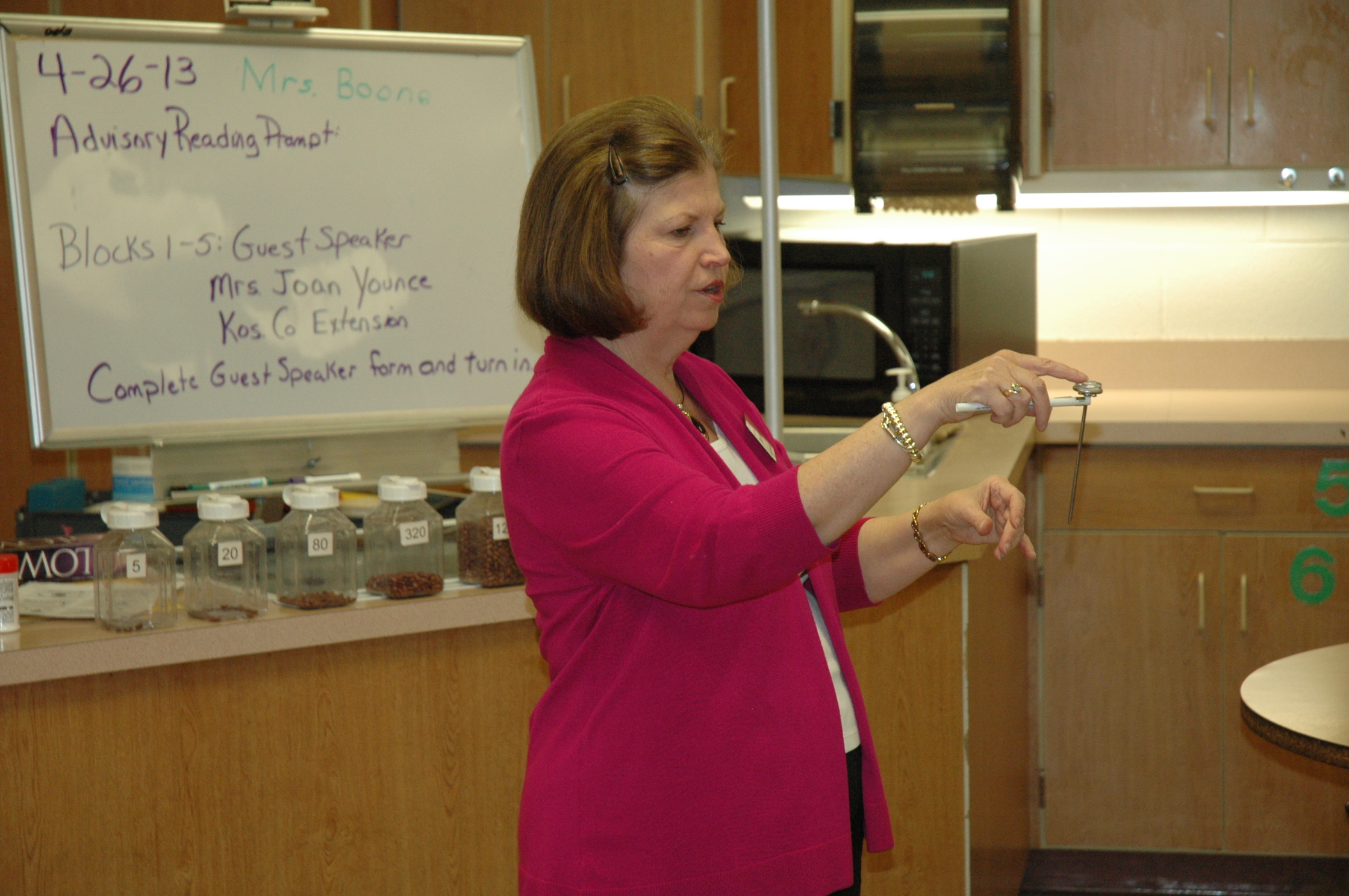
Not all bacteria is bad when it comes to food, but much of it is and caution should be taken to eliminate as much of it as possible when cooking.
Joan Younce, Purdue Extension Office for Kosciusko County, spoke to Darcy Hively’s family and consumer sciences classes Thursday and Friday at Wawasee Middle School as part of Fight BAC (short for bacteria), a program focusing on the four principles of food safety of clean, cook, chill and separate. The goal of the U.S. Department of Agriculture program, which is specifically for middle school students, is to keep bacteria from food as much as possible.
Some bacteria is good, Younce noted, such as that used in yogurt and cheese products. But those are exceptions and usually steps need to be taken to get rid of bacteria. It can’t be seen, tasted or smelled, but it can spread throughout the kitchen and get onto countertops, cutting boards, utensils and food. If eaten, food borne bacteria can cause illness and, sometimes, serious illness or even death.
She cited examples of food borne illness causing major problems, such as one found in eggs that came from a farm in Iowa. As another example, during one of Younce’s presentations Friday morning to eighth-graders, one student noted she had food poisoning and was sick for an entire week.
Certain population groups are considered more at-risk for developing a serious food borne illness, including the elderly, smaller children, pregnant women and those with compromised immune systems such as those cancer. Younce pointed out chemotherapy for cancer patients can make them weaker and more susceptible to illness.
Keeping hands clean is important when handling food. Hands should be washed thoroughly before and after preparing food, she emphasized. Cutting boards, utensils, dishes and countertops should also be washed with hot soapy water after preparing each food item and before going on to the next one.
Cooking foods at hot enough temperatures will kill bacteria. Younce provided students with papers including a chart of some basic food items and what temperature they should be cooked at.
Chilling food in a refrigerator does not kill bacteria, but will slow its growth, she said. The temperature should be at 40 degrees or below. Food should not be left out and exposed to room temperature for more than two hours, she noted, according to health department guidelines.
Separating involves washing hands before and after handling food and after using the bathroom, changing diapers and handling pets. Don’t use the same cutting board for fresh produce as is used for raw meat, poultry or seafood. Keep raw meat, poultry and seafood from other foods in the grocery shopping cart and the refrigerator and prevent juices from raw meat, poultry and seafood from dripping on other foods in the refrigerator.
Hand washing demonstrations were done for students.