The ABCs Of CBD
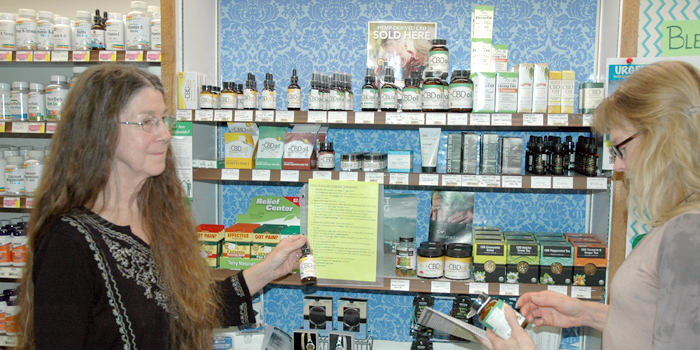
WARSAW — The latest hot trend by far in natural pharmaceuticals is CBD oil.
The product was legalized for sale in Indiana last July, and consumers have been patronizing outlets from convenience shops to natural food stores to snap up CBD — technically, cannabidiol — in its various incarnations: oils taken under the tongue or in food or drink, capsules, salves, lotions, soft gels, gummies, tea and vape.

Though long-term studies have not yet been conducted and the U.S. Food and Drug Administration has not approved CBD for the treatment of any condition, clinical studies and anecdotal references indicate its effectiveness in alleviating symptoms of epilepsy, autism, arthritis, attention deficit disorder, lupus, fibromyalgia, anxiety and a variety of other ailments.
The World Health Organization reported there are no public health problems associated with the use of pure CBD.
CBD is derived from two sources, marijuana and the hemp plant, a botanical cousin with little or no THC, the cannabis chemical that produces the “high” from using marijuana.
The CBD products legalized in Indiana must adhere to three strict guidelines:
• It must be derived from industrial hemp, not marijuana
• It may not contain more than 0.3 percent THC
• It cannot contain any other controlled substance
In addition, each product’s packaging must include a QR code — the black and white grid read by smartphones — containing information such as batch number, expiration date, ingredients, test results and independent lab analysis.
Retailers who knowingly sell marijuana disguised as CBD oil can be charged with a level 5 felony and face up to six years in prison and a fine up to $10,000. Individuals possessing marijuana made to look like CBD oil are subject to a class A misdemeanor with up to one year in jail and a fine up to $5,000.
Jamie Kinner, manager of Warsaw Health Foods, 1228 E. Center St., said, “I have never seen anything like it. We have people who started taking it for one reason and found out they got other benefits.”
Because CBD is all natural, “there is no toxic dose,” said Kinner. “It doesn’t take a lot to notice a benefit, and more is not necessarily better.” She suggested individuals “start with a very little dose and work up to the point where you find benefits.”
Because so many manufacturers have saturated the market, Kinner recommends caution in selecting a brand of CBD. The quality of CBD purchased online varies greatly and may result in money wasted on inferior products.
“We only deal with companies who have a very clean process and we look for not a lot of preservatives or additives,” she said. “We buy only from companies who are part of the Natural Products Association. We have a guarantee from these companies.”
Kinner has noticed a positive trend in the medical community. “The good news is we are hearing doctors telling their patients to give it a try.”
Kinner and her staff are “always careful to tell our customers we are not doctors and we never tell them what CBD can do.” The store does, however, display a sheet of summarized testimonials from satisfied users.
One downside of CBD use is the price. The products are not covered by insurance and some users cite a cost of $500 a month to treat themselves, though that figure applies to cases of extreme chronic pain or other severe ailments.
For more information, call Kinner at (574) 269-2413.