A Court Of Peers For Teens In Trouble

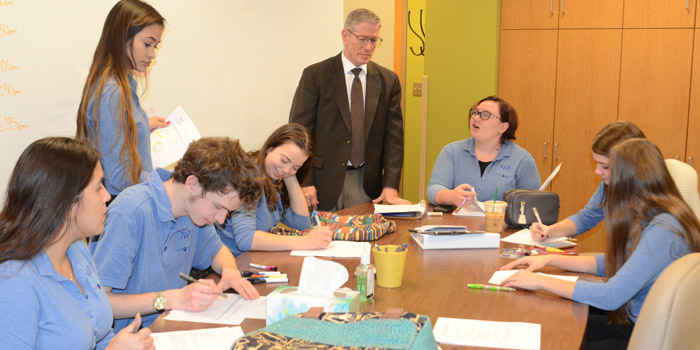
WARSAW — Something needed to be done as the case load in juvenile court has been increasing. A little more than a year ago Kosciusko County started the teen court program. “We have had really good results,” said Marsha Carey, Kosciusko Cares, who oversees the program.
Teen court is for teens who have committed low-level offenses to appear before their peers to determine a resolution. Most cases involve truancy, runaways, fighting, theft, use of alcohol, marijuana, vaping and tobacco. “These low level offenders have an opportunity to atone for their misdeeds while also avoiding a juvenile record,” said Kosciusko Superior 1 Judge David Cates, the county’s juvenile judge. “The students involved in the program are receiving an education into the judicial system. I am appreciative of the efforts of those involved in teen court.”
“Marsha Carey had a vision for a Teen Court program and with the help of many others; brought that vision to fruition. The program has been very beneficial to the juvenile probation department,” said Dana Bailey, juvenile probation officer. “The program has allowed time for the probation officers to dedicate more time with higher risk juveniles. The participants, both offenders and those youth serving as officers of the court, gain much insight. Most importantly, the offender’s participation in Teen Court keeps them from obtaining a juvenile record, while delivering a restorative conclusion to the case.”
Teen court is conducted just like every other court hearing, but with a jury of peers. Teen court members alternate cases as prosecutor, defense attorney, court clerk and bailiff. Teen court is held twice a month, handling four to five cases each time. John Barrett, local attorney, presides as judge. He explains the process and hears the presentation by the prosecution and defense counsel. He’ll also speak frankly to the participant and ask his own questions.
Once the court is recessed, Barrett, Carey and her assistant, Barb Hatfield, meet privately with the peer jury. Thoughts are shared, questions asked and a decision reached. Upon returning to the courtroom, the decision is read. Carey and Hatfield meet with the participant and parents to finalize the contract.
The decisions are “not intended to be a punishment, but to repair harm to self, others in the community, learn how others are affected, learning new skills, manage stress, make better decisions and keep making good decisions,” Carey stated. The restorative justice program’s three sectors are used by the peer jury. These include community, individual competency and personal accountability. This could include a strengthening families program, service on the peer jury, tobacco education, counseling, essays or research projects, learning opportunities, tutoring, apology letters, restitution and action plans. “The team can be creative if something is not on the list.”
One of the most favorite programs is participating in The Wild, a survival skills program at Quaker Haven.
“Teen court is a very exciting program,” said Barrett. “I feel like if we can get a hold of some of these young kids and get them on the right path before they become adults, the recidivism rate would be lower. … maybe they can avoid the adult system.”
Carey stated almost 156 cases have been referred to the court from juvenile probation. More than 100 cases have been accepted, approximately 56 returned to probation for a variety of reasons. Carey and Hatfield review the cases, interview the parents and participant. “If the participant accepts the responsibility for what he/she did – it’s not an admission of guilt – and willing to make a change, they are accepted,” Carey said, adding participant’s strengths are determined for a greater success.
The teen court is comprised of high school students, mostly juniors and seniors, who have applied to participate. The members undergo restorative justice classes, hear from probation officers, deputy prosecutor, defense attorney and take a teen court bar exam. An oath of office is administered and a confidentiality agreement is signed. “They are role models for other youth,” Carey said.
“I love to help people,” said Kayla Smith, a Warsaw Community High School student and member of teen court. “I feel I’m making a difference.” Leslie Tayagua, a Wawasee High School student, stated. “I’ve always been interested with law … I like working with kids my age, helping them better themselves after they’ve done something wrong and to guide them to the right path. I feel like not many people do that and it’s important for us to do it so later on in the future they don’t end up on the wrong path.”
“I’d say it’s a good thing for kids like me, who’ve done something bad,” said one of the participants who was directed to serve on the peer jury. It gave him an opportunity to “see the other side of this and help other kids … even though you did bad, it’s nice to know you can help and are helping someone else.”
