Math, Academic Assessments Discussed At WCS Work Session
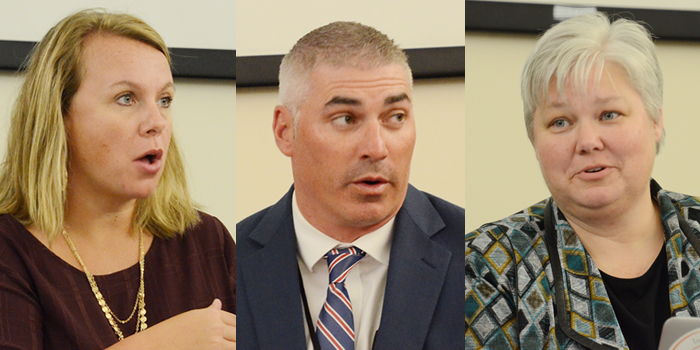

WARSAW — Students and teachers in Warsaw Community Schools will be ramping up math education, as well as implementing measuring tools to gauge the progress of the school system’s students in a variety of subjects.
At WCS’s board of trustees monthly work session Tuesday, Sept. 11, the board heard presentations from several faculty and administrators about ongoing educational programs within the district.
Dr. David Robertson, WCS chief academic officer, told the board that math education was getting additional attention as part of a long-term plan.
“One of the initiatives that came out of our strategic plan summit a couple of years ago was a math framework team, specifically at the elementary,” said Robertson. “From a curricular perspective, for years, we’ve had a reading framework that’s been pretty straightforward for our teachers and we’re always looking to improve that.”
To help illustrate new initiatives in math education, Robertson passed the presentation to Cheri Sleighter, WCS’s new math coach for grades kindergarten through sixth grade.
“Cheri has helped in regard to thinking about best practices when it comes to the delivery of mathematics and how are we going to implement those,” said Robertson.
Sleighter told the board that math education at WCS would equip educators with greater empowerment and would also be collaborative at the student level.
“As we’re looking at our math classes, we want the teachers to have the flexibility to do what works best for their students and be responsive to their students needs,” said Sleighter,” adding that students would be brought together multiple times each week to discuss the subject among themselves to help bolster understanding.
To enable educators to better measure student success, Chief Analytics Officer Shelly Wilfong said to the board that students from kindergarten through 10th grade would receive assessments provided by the Northwest Evaluation Association.
“It’s a measure of academic progress,” Wilfong said. “We give this assessment to all of our students grades K through 10. Typically, it’s given around four weeks after school begins and it mitigates the summer slide of students’ knowledge and understanding, helping them to get back into the swing of things.”
Wilfong said another assessment is given in the spring and that such a test is also available in the winter, but left to the discretion of individual teachers.
During the assessment, Wilfong said questions become more difficult as the test continues, which can create an unintended consequence with the more conscientious of students. “Because of that, you have some students who hate getting the wrong answer,” Wilfong said. “So, they will sit there and dwell on a question for a long time, trying to figure out what the correct answer is.” Wilfong said teachers are encouraged to help students learn to move on in order to complete more of the timed assessment. Student are also compared to their peers across the country.
“We can see how students progress from kindergarten, all the way up to 10th grade,” Wilfong said. “It’s a national test, so we can see how our students do in relation to other students throughout the country.”
In other business, Director of Maintenance, Buildings and Grounds Jim LeMasters gave the board a progress report on the construction of the high school’s new Student Activity Center. LeMasters said the new chiller was installed, taken several hours since clearance for the large piece of equipment was as small as a quarter inch. LeMasters invited the board members to take a tour of the facility’s progress.