The Sticky Truth Behind Turning Sap Into Syrup
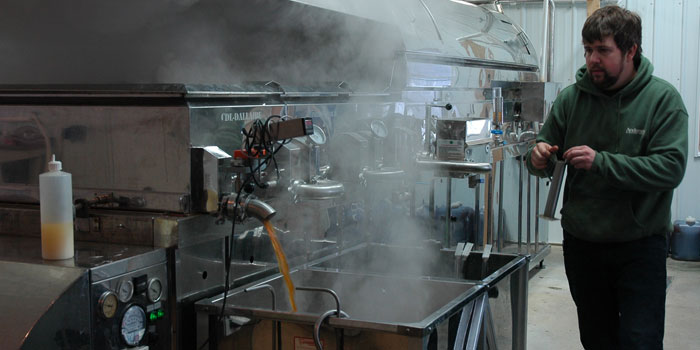

CLAYPOOL—This weather, with the temperatures fluctuating between freezing and spring-like, has made for a longer and fruitful maple syrup season. Beachler’s Sugar Bush, Claypool, was able to begin tapping its first maple trees as early as Jan. 6, weeks earlier than in previous years.
The business is run primarily by Silas and Anna Beachler with the assistance of Silas’ father, Lamoine. Family and friends also come to assist during the season with collecting sap, getting sap into the storage bins and bottling the finished syrup. Silas and Anna’s work is overseen by their son Lars, 2, and their infant son, Sterling.
When Silas was 11 years old, Lamoine Beachler stated his son said he wanted to begin making syrup. Having watched family members in Canada make syrup, Silas wanted to do it himself and he “was not afraid to work.” Beachler started his son with 50 buckets in the maple trees behind their house. Today their operation has grown to thousands of taps on three different properties.
While Silas began with a small 2 foot by 6 foot evaporator in 2002, he now has an evaporator large enough to not only make syrup from his own sap but also the 30 to 35 individuals who bring their sap for him to boil.
How is maple syrup made?

Once a tree reaches 12 inches in diameter, one can begin tapping. Depending on the size of the tree, one or two taps may be added each year in a new location in a spiral pattern around the tree. Once the buds on the maple tree begin to swell, the sap changes flavor and is no longer good for making syrup.
Although gathering sap from maple trees is commonly visualized with a tap and a bucket, a larger operation like the Beachlers normally uses a tubing and vacuum process. The tubes are connected to the tap with main lines taking the sap to the pump house and then to the storage containers. The Beachler family has more than 7,000 gallons of sap storage available.
Sap from the storage tanks flows into the reverse osmosis tanks in which the majority of the water is removed from the sap. An outdoor storage tanks hold the concentrated sap until it is ready to go to the evaporator. Tubes using gravity flow take the concentrated sap to the evaporator and the steam from the evaporator helps to preheat the sap. The concentrated sap then moves through the evaporator, removing the rest of the water.
Occasionally a drop of defoamer is used to keep the syrup from boiling over or foaming. Once the correct temperature is reached the syrup comes out of a spout into a holding tank. Diatomaceous earth is added to the holding tank and the syrup goes through a filter, with the diatomaceous earth helping to trap the sugar sand in the filters.
From the filter pure maple syrup comes out. The pure maple syrup is then either sent to the canning machine where it is heated to 180 degrees and placed in bottles or put into 55 gallon drums to be canned later. On average 40 gallons of sap will make one gallon of syrup. The higher the sugar content, the less sap is needed to make syrup.
Silas also uses his maple syrup to make maple sugar and products such as maple covered almonds. His syrup and other products can be found at local farmer’s markets, such as the Warsaw market, approximately a dozen local stores or even at their own home. Those who are interested in beginning their own maple syrup operation can also find maple sugaring equipment and supplies from Silas Beachler’s second business, Sweet Beginnings Maple.
Indiana Maple Weekend is celebrating its second year allowing people to visit sugar maple operations throughout the state March 11-12. To see how the process works up close, Beachler’s Sugar Bush, 9569 S. 600E, Claypool, will be open for visitors from 8 a.m. to 4 p.m. Saturday, March 11.