Open House An Eye-Opener: AWL Facility Designed For The Future
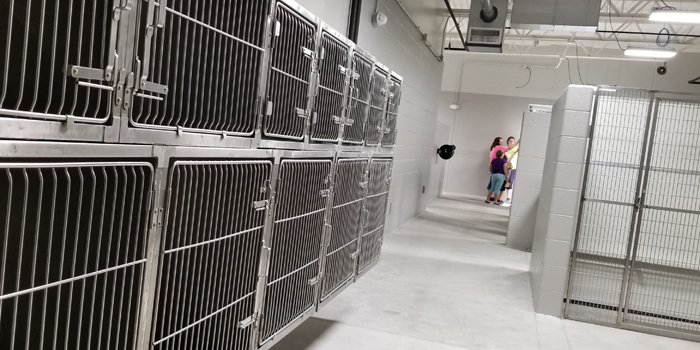

WARSAW — As Sandra Buchanan and her husband, Gary, strolled from room to room at the new Animal Welfare League shelter Saturday, her eyes began to tear up.
Buchanan used to volunteer at the old, soon-to-be-empty shelter for several years, so she is familiar with the hardships, difficulties and limitations of the old, smelly, dilapidated building just down the road from the new facility at the corner of US 30 and CR 325E.
Her first chance to see the $2.8 million shelter brought about a sense of astonishment in the contrast from the old and excitement over the numerous new amenities.

The Buchanans were among several hundred people who visited the new shelter Saturday, Sept. 14.
At 13,000 square feet, the new building is almost twice as big as the old one and will be able to serve twice as many animals.
Among the benefits, the rooms housing animals will be much easier for staff to clean and the public can expect a much, much more pleasant smell when they visit.
“More important is what it will do for the animals. Shelters are an incredibly stressful environment and you see behavior from dogs and cats that you don’t see in a calm environment and so they don’t get adopted because they don’t show right,” Buchanan said.

Carl Abbott, AWL’s operations manager for more than six years, was one of several people giving tours.
“To see it done is overwhelming. It’s such an accomplishment that we got this far,” Abbott said.
Abbott and Katey Wilks Zemen, the executive director, both said the new facility eliminates numerous headaches and shortcomings they’ve had at the old shelter.
“As far as cleaning, it’s going to be a lot easier,” Abbott predicted.
Wilks Zemen was ecstatic about the new shelter. “I love talking about this building,” she said.
Four sections of the building have separate HVAC air systems to help reduce air-borne illnesses.

The floors in rooms housing animals are slopped so that urine and other messes can be easily washed into troughs and drains. An underground flushing system in the rooms will allow employees to displace lingering waste and send it into the sewer system — another way that will reduce lingering smells.
Abbott said the flushing system likely sets AWL apart from other shelters.
“I fought for that,” Abbott said with a grin of satisfaction.
There are separate areas for animals that are ready for adoption, one for animals not ready for adoption and a third for those that are new or sick.
The isolation room is big enough to accommodate hoarding cases that sometimes involve dozens of cats or other household animals. Previously, under those circumstances, the shelter would immediately start reaching out to other shelters for help.

“Most of the time, these kennels are empty, but the one time where we’re getting 30 malnourished (cats), this is where they will come and get better,” said Wilks Zemen.
The isolation area includes a lab room and an exam room with an examination table that can be raised automatically for large dogs. That will eliminate the need to wait for somebody strong enough to put big animals on a table.
The isolation area was designed with a side room accessible from the outside where animal control officers can drop off animals overnight.
Other unique features:
- There is a pet food kitchen where all food is prepared and dishes are cleaned with a restaurant-style dishwasher
- There is a grooming room where heavily matted, flea-bitten animals can be cleaned up. The equipment was donated by the grooming store, Underground Hound. Company owner Ben Bingham said his staff will be available every other Wednesday to do non-emergency haircuts.
- There is a laundry room with new washers and dryers that were donated.
- Partnered dogs — sometimes siblings — will be housed in special adjoining cages where doors can be easily opened for interaction.
- A long hallway that circles around part of the building will be used as a walking track for dogs during the winter months.

Many of the rooms are dedicated to honor longtime supporters and those who helped pay for the project.
A special tribute along a wall in the lobby recognizes, among others, Darla McCammon, a former executive director who began pushing for a new facility years ago and led the fundraising efforts. She retired about two years ago.
A plaque credits McCammon with the vision for the new shelter.
“She dedicated so much of her time and effort to making this happen,” said Wilks Zemen. “It was sad that she had to retire before we could make that happen, but this is still her building. This is something that she put together and we needed to make sure she was honored for all the work she did.”
AWL Board Member John Hall toured the building Saturday and said it looks great. He said he believes it is the first shelter in Kosciusko County that was actually designed to be a shelter.
The new facility will open beginning Sept. 28.
“Not only do the animals deserve better, but the volunteers and employees deserve better than what we had over there,” Hall said.