Two-And-A-Half-Hour Warsaw Council Meeting Ends With Approved Sewer Rate Increase

WARSAW — A long Warsaw Common Council meeting held last night, Nov. 19, was full of public discussion and ended with the sewage rate and charges ordinance passing 5-2, with the exact same people voting for and against the ordinance as on first reading.
For this second phase of the rate increase, the city decided to switch to a cost of service billing method. This means that customers will be charged on their usage, and the raise is not an across the board hike. This increase is necessary because of the $10 million collection system project in 2017 and the current $31 million wastewater treatment plant expansion which is expected to start construction in 2019.
The average residential unit, based on a usage of 4,000 gallons per month, will see a bill of $41.15, around a 26 percent increase from current bills. That total increase is less than what was originally forecasted in 2017. Examples were provided for both a business with a 1-inch meter using 11,000 gallons per month and a 2-inch meter using 89,000 gallons per month. The 1-inch meter customer will see a new bill of $108.68, a 51 percent increase, and the 2-inch meter will see a bill of $695.70, a 42 percent increase.
Both Jeffrey Rowe of Umbaugh & Associates and Warsaw Mayor Joseph Thellamer made small presentations before the public hearing portion of the meeting.
Rowe clarified that at the last meeting, an apartment bill was incorrectly calculated. Lakeland Villas operates under two different business entities, but only one business entity was used for the example. This changed the apartment complex example from seeing an 11 percent decrease to a 9 percent increase. Rowe stressed that these were just examples presented for informational purposes and that the actual cost of study data was not impacted by this mistake.
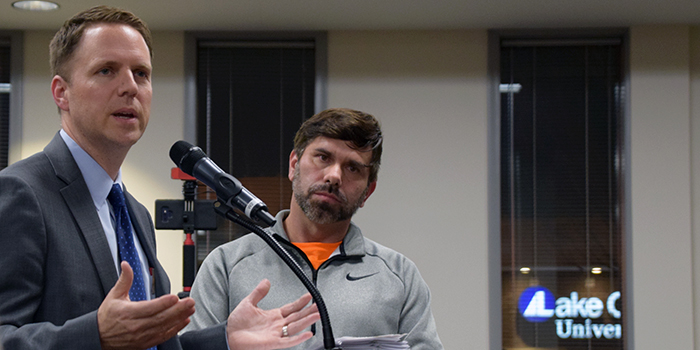
The public hearing section of the meeting took up the majority of the time. During this period, six different citizens and business owners came forward to give their opinions on the ordinance and ask questions.
Warsaw resident Chad Zartman spoke the longest during the public hearing. He was the citizen who brought up the error in the Lakeland Villa example at the last meeting. He questioned the error and wondered why Lakeland Villa was chosen as the example when other apartment complexes in the area have more water usage.
“That one seems to be on the low side … just seems like there was an incentive to show a lower increase.”
Rowe stated, “At the end of the day, there’s no incentive … it was a simple mistake.”
Zartman also brought up the fact that the Cost of Service study was given to council members a little over three weeks ago. He said that local business owners, Warsaw residents and the council would have benefited from more time to review the study.
Mayor Thallemer pointed out that there was a $5 million difference between initial project estimates. “Could you imagine if I would have put that study out with the low amount of $26 million and it came in at $32 million. How much fun would you have had with that, Chad?” Thallemer stated that if he had to do the process again, he still wouldn’t release the Cost of Service study until he had the official bids in.
Ashley Finney, manager of Quick Clean Laundry, spoke to the council about how the rate increase would affect her business and other businesses that cater to the lower-income population of Warsaw.
“I understand that an increase may be a necessity as we are at compacity. What I don’t understand is why the increase is different based on location … We’re hearing it will be higher for Warsaw than anyone else. We’re hearing it will be higher for small business than for anyone else,” said Finney. “We make our money 25 cents at a time. Providing our service to low-income families, rental communities that are already financially hit in Warsaw. We took the loss on the bottom dollar on the last increase and I cannot afford to do that again with this one.”
The main questions from the public seemed to be why the rate increase needed to be done in one increase and why it could not be an across the board raise. Rowe and various councilmembers explained that an ordinance needed to be in place before the city could obtain its State Revolving Fund loan and the ordinance’s rate increase must be able to support the loan by bringing in adequate revenue. It was also explained that instead of an across the board raise, the city felt it appropriate that everyone is charged for exactly what they were using.
At the end of the meeting, the council voted 5-2 to pass the ordinance on first reading. Council members Ron Shoemaker and Cindy Dobbins opposed. It was noted that the council wished to keep the sewage rate committee together and continue to study the ordinance and rates. Future amendments to the ordinance are possible.
In other news:
- Ordinances for the Scroggs, Williams and Eisenhower/Miller annexations were approved on second reading. The public hearing and fiscal plans were heard at the last council meeting.
- The council approved amending section 2-240 of the Warsaw City Code. This amendment allows the hearing officer to enforce the city and building codes. The council suspended the rules and passed the amendment on both first and final readings.
- Reductions from the 2018 budget were approved in the amount of $950,000.
