First Public Meeting Held In US 30 Freeway Project Discussion
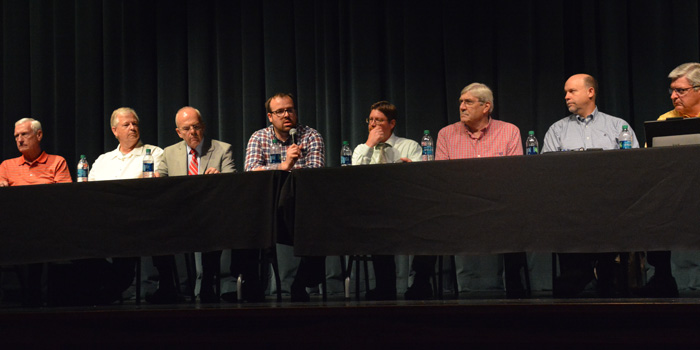

KOSCIUSKO — Crash statistics and citizens’ concerns were the main topics of discussion last night, May 24, during the first public meeting on the US 30 freeway project.
Approximately 100 Kosciusko County residents attended the meeting at the Warsaw Community High School Performing Arts Center to meet with elected officials, local stakeholders and representatives from the US 30 Coalition regarding the concept.
Currently, the US 30 freeway project plan involves constructing the road into a limited access freeway in order to improve safety and traffic flow. In total, seven counties in the US 30 corridor are involved in this plan. This includes Allen, Whitley, Kosciusko, Marshall, LaPorte, Starke and Porter counties.
Design and engineering by INDOT will not begin until project funding is identified and an environmental study is completed.
During the meeting, traffic count and accident data along US 30 were presented to the audience. On average, US 30 has about 30,000 vehicles on the roadway per day. Roughly 20 percent of that traffic are semi-trailers. In 2035, these numbers are projected to rise to 38,000 vehicles, with 31 percent being semi-trailers.
From 2011 to 2016, at the Parker Street and US 30 intersection alone, there have been 127 vehicle accidents. And from 2014 to 2016, there have been 11 fatalities in crashes that occurred at US 30 intersections in Kosciusko County.
“We want to make the community more aware about this project, and also remind everyone that the main focus here is on safety,” said Mayor Joe Thallemer.
County Commissioner Cary Groninger stated that there is no project at this point, as community input is being asked for regarding the final project design. “This is an important project,” said Groninger. “People and businesses really rely on US 30.” Groninger also stressed the importance of an environmental study, noting that with the county’s lakes and poor soils, the study would be one of the first tasks completed.
Dennis Faulkenberg of Appian Consulting presented parameters for the project, stating that the plan must work for each community. “Everybody has a say in every county,” said Faulkenberg. “If we talk about it now, we can make the decision.”
On the US 30 portion in Kosciusko County, there are 12 stoplights, 17 intersections and 34 driveway cuts. In comparison to other counties involved in the project, Kosciusko has one of the highest numbers of stoplights along the roadway.
Faulkenberg stated that the freeway is needed due to high truck volumes and crash severity. “It’s a tremendous project for INDOT to deal with,” said Faulkenberg.
The project is estimated to cost $1 billion. Faulkenberg also mentioned that in his first state address, Governor Eric Holcomb discussed making US 30 a freeway.
James Turnwald, executive director of the Michiana Area Council on Government, and Jeremy Skinner, Warsaw city planner, also presented statistics on US 30. The three roadway intersections with the most vehicle accidents include Center Street, Old US 30 and Parker Street.
Toward the end of the meeting, panelists spent more than an hour answering the public’s questions and addressing their concerns.
One citizen asked if more farmers will be placed in the stakeholder operations, as the project will affect farm land. Currently, there are two farmers involved. Both Groninger and Thallemer stated that more farmers will be placed into the operation, stating that since it’s unknown what land the freeway will affect, not many local farmers have been reached out to yet.
“This group will be added to and subtracted from whenever necessary to better benefit the community,” said Thallemer.
Skinner emphasized that there will be plenty of public meetings to come, with one scheduled for sometime this fall.
“We’re only here tonight to kick the process off,” said Skinner.
Jill Boggs, executive director of the Kosciusko County Convention and Visitors Bureau, also asked the board to consider the hotels near US 30 and their economic impact that they have on the community.
Many community members also thanked the panelists for taking this approach and holding the meeting to get the community involved.
The meeting concluded with Thallemer stating that the PowerPoints from the meeting will be posted on the city’s website, and that a meeting will be held in the fall.
