Warsaw Orthopedics Recognized In Helping With Rare Bone Disease

WARSAW — Fibrous Dysplasia is a rare bone disease, occurring one in every 10,000 births. It’s a gene mutation that occurs in the womb and is oldest known bone tumor disease, the earliest discovery dating back 400,000 years ago. Despite it being the oldest known bone disease there is little information on it.
FD can affect any bone in the body in various ways, turning it into a fiber tissue that grows uncontrollably and becoming fragile enough to break a rib from a sneeze or a femur from stepping off a curb. There is no cure or medicine for it, which means people with FD have to deal with the constant pain and struggles that come with it.
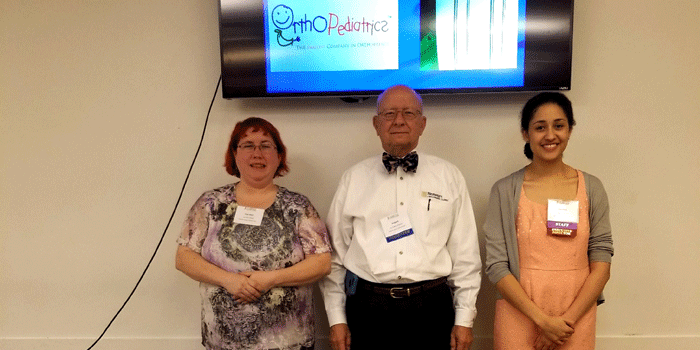
Lee Ann Brown, 40, Warsaw, recently attended an orthopedic conference in Silver Springs, Maryland, where she was able to meet doctors who work with FD, see what treatments are being worked on and gain new information. It was also a chance for her to be surrounded by others who had the disease and shared similar experiences she’s had in life.
“I have hearing problems,” explained Brown. “If I’m focusing that you’re going to talk to me, I can hear you but if I’m off in my own little world, I’m not going to. I was always told “Oh, you have selective hearing” and “You only hear what you want to hear.” That isn’t it at all. So it was great being around other people who have also gone through similar situations. They understand.”
When she was younger Brown began failing school hearing tests. Nothing was said to her parents until she entered high school. By then her ear canal was enclosed. Doctors believed that if they drilled it out, it would stop and the problem would be solved. Later it was discovered that surgery and removal of the affected bone actually sped up the growth. While she has only had to have two surgeries during her life, many others aren’t so lucky.
Due to the way the disease operates, it can be invisible or glaringly obvious. Some have facial deformities, causing unwarranted staring from strangers. Others may have their hip or knee impacted, giving the access to a handicap spot to utilize on the bad and good days.
“You might see someone who looks perfectly normal parking in a handicap spot.” She elaborated. “You’re probably going to assume there’s nothing wrong with them but you don’t know what that person’s going through. It might be a good day for them where they don’t need their cane. Don’t let assumptions go on. Even if you don’t understand, someone else might be going through something different.”
At the conference Brown felt herself swell with hometown pride in seeing many of the orthopedic companies in Warsaw recognized. Warsaw is the orthopedic capital of the world yet many probably don’t understand that the implants aren’t just going to senior citizens who broke a hip, but young children with FD.
“You think this is a small little sleepy town. You don’t think about what’s in it,” said Brown. “If somebody’s getting an implant, odds are it’s coming from this town. Most people who work in the orthopedic industry here don’t think beyond the idea that it’s a senior citizen needs a hip. They don’t realize how much of a part they play. It makes a huge difference in what this town does.”
For more information, visit fibrousdyslplasia.org.