White Presents Winsome Winona For Historical Society
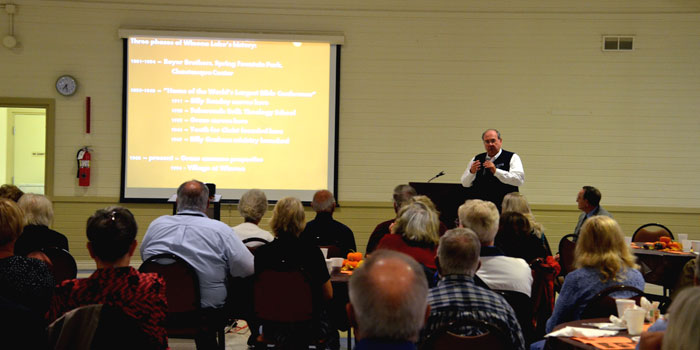

WARSAW — As part of its 52nd annual banquet Thursday night, Oct. 19, the Kosciusko County Historical Society invited local historian and Grace College instructor of journalism Terry White to present “Winsome Winona” to 106 guests. In what may be the fastest recap of 150 years of history, in 45 minutes White presented the history of Winona Lake in its entirety.
White prefers to break the history of Winona Lake up into three sections – 1881-94, 1895-1968 and 1968-present -with the earliest section being the era of the Beyer brothers, followed by a long religious and evangelical era and the build up of Grace College and the Village of Winona.
While some of what White presented was well-known information, such as the history of Billy Sunday, he was rife with interesting facts about Winona and the people who lived there.
Paul Lowman, who lived on Sixth Street, owned a lion named Jerry that he trained to water ski. White stated that Lowman owned three lions over time, shooting the last and burying it somewhere in Winona Lake. “We have a very large prize for the person who can find where the lion is buried,” said White.
White also spoke of the “great tragedy in Winona Lake,” the 1914 fire that destroyed 23 homes on Chestnut Street. Then valued at $100,000, it would now be valued at over $2.6 million. The fire was sparked by burning leaves on the lawn of the Winona Hotel. The sparks got away and began catching homes on fire. With no proper local fire team, a team decided to blow up houses in the path of the fire in hopes of stopping it. A telegram man telegraphed over to Fort Wayne requesting firemen to take the train into Winona Lake. They brought with them a pump that they placed in the lake to pump up water to extinguish the fire.
Some may also find it curious that the canal was dredged in 1902 purely for aesthetics, allowing for boat parades and other activities. It was paid for by the President of Standard Oil of Kentucky Alexander McDonald. It was the dredging of this canal that made it possible to put housing on the island, the first house being Killarney Castle.
If you are interested in more of Winona’s history, White is a docent in the Museum of Winona History, located in Westminster Hall at 105 Ninth St., Winona Lake, Tuesday through Friday. You can also pick up a copy of his book “Winona at 100 Third Wave Rising.”