2017 IMA Regional Summit Shines Light On Manufacturing
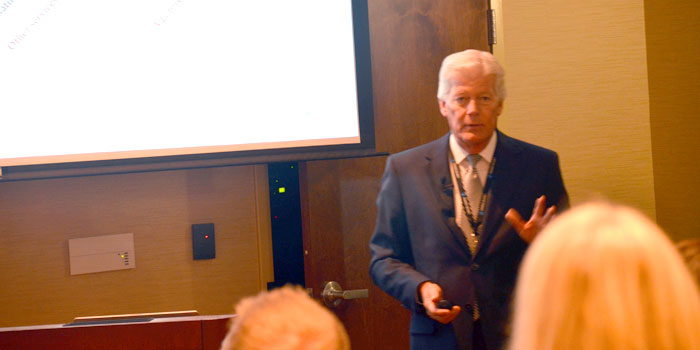

WARSAW — The message at the Annual State of Indiana Manufacturing Tour and Regional Summit that took place at Zimmer-Biomet Aug. 23 was clear: teens and young adults entering the workforce should look towards manufacturing.
Indiana Manufacturing Association President Brian Burton presented a number of details regarding Indiana’s income and job market statistics. One of the more important numbers mentioned was that 29 percent of Indiana’s GDP is generated by manufacturing, equivalent to $98.4 billion. Comparably, agriculture makes up only 1 percent at $4 billion.
Indiana is the most manufacturing intense state in the country, according to IMA, and has had the second highest increase in manufacturing jobs since the economy began to upswing in 2009. Over 100,000 jobs have been added, totaling an estimated 526,394 jobs by job function. Burton believes this number is undercounted by at least 100,000 jobs that were interpreted as being in the service industry.
Burton was also quick to discuss Indiana’s wages, with manufacturing paying out some of the highest wages and benefit compensation in the state. The average total compensation in manufacturing last year was $73,000 for the year. All other sectors averaged only $46,000.
A number of graphs and statistics made it clear that the manufacturing industry is not disappearing anytime soon. With the production and sale of vehicles holding steady and the rate of new housing increasing, manufacturing jobs are still in demand.

The unfortunate reality is that despite manufacturing dominating the workforce, the number of skilled workers looking to go into manufacturing is stagnant. IMA’s Vice President of Workforce Development, Stephanie Wells, was present to discuss some of the challenges of recruiting young adults into the workforce.
Burton had mentioned in his presentation that seven out of 10 Americans believe the United States should invest more in manufacturing, but one-third of parents would not encourage their children to pursue a job in manufacturing and 64 percent of those surveyed didn’t think manufacturing paid enough.
Once a dirty and underpaid job, the IMA wants to shine a new light on manufacturing. “We still have this perception that it is dark, dangerous and dirty. They have not seen what is in these facilities,” said Burton.
But career counseling in middle and high school’s is tough. Wells announced that many Indiana school counselors are responsible for 500-600 students. Most of a counselor’s time is, understandably, taken up by personal development and social issues, leaving little for proper career counseling.
A career assessment tool through the Department of Workforce Development will be piloted in 16 Indiana schools, in the eighth grade, starting in 2018. However, of 38,000 assessments that have been done to date, only 12 students have been directed to a career in manufacturing.
“We continue to pester and meet with DWD staff…to talk to them about this assessment tool and how it needs to be massively recalibrated in order to make it something that’s worthwhile to continue to use,” Wells said.
The ultimate goal is to introduce more high school students to the availability of prosperous careers within the manufacturing industry and to get those students into skill building programs to prepare them for a career in manufacturing.
To help bring new employees into the industry, IMA proposed to policymakers an employer training tax credit. Wells stated that the proposal has seen no public pushback. Governor Eric Holcomb has since recently announced an Employer Training Grant. The grant allows employed in high demand sectors to be reimbursed up to $2,500 for each new employee that is trained, hired and retained for at least 6 months. The jobs must be “middle skill, high-demand and high-wage jobs”, as defined on NextLevelJobs.org, that require at least one college course but less than an associate degree. Employers are capped at $25,000.
A Workforce Ready Grant is also available, and helps pay tuition cost for working-age Hoosiers earning a “high-value” certificate at Ivy Tech Community College or Vincennes University.
Wells also spoke on relocation incentive to bring skilled workers into Indiana to live and work. According to Indiana University’s Public Policy Institute, between 2010 and 2040 Indiana’s workforce is expected to rise only one percent. Incentives have not yet been defined.
Wells concluded that IMA will continue to advocate “for a business climate that creates, protects and promotes quality manufacturing jobs in Indiana.”