Turkey Creek Fire Department Depends On Full And Volunteer Firefighters
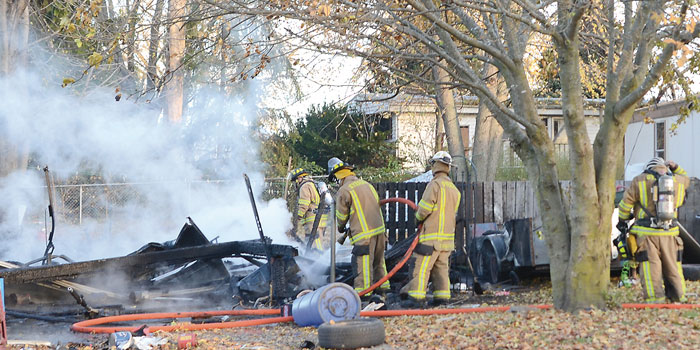

EDITOR’S NOTE: This is the first of a three-part series on the Turkey Creek Fire Territory Fire Department)
SYRACUSE—For years it was the Syracuse Fire Department, operating with two separate budgets; one from the town and one with the township. Even the tax rate for those they served were different. There were three full-time firefighters and more than 25 volunteers responding to calls.
In 2009, the department became Turkey Creek Fire Department, operating under one budget and governed by a fire territory board comprising of representatives from the town and township. The tax rate became flat across the board. The department moved to a full-time department with a staff of 14. The volunteer roster remained over 20. “It’s critical to have both full (time) and volunteers,” said Mickey Scott, fire chief.
One thing that hasn’t changed, the EMS service has remained a part of the fire service.
The department operates with three shifts of four firefighters. Two are at Station 1, two at Station 2, 24/7. These individuals are paramedic/firefighter and either an EMT or advanced EMT also cross trained as firefighters. “At any given time there are four guys on, plus a volunteer,” Scott explained. A volunteer with the EMS now sleeps on station, at Station 1. “We have a three minute door time requirement,” he said. This means if a call comes in at 2 a.m. the responder has three minutes to get up, dressed, figure out where they are going and get out the door.
But there have been other changes, only noticeable behind the scenes. State and national requirements for fire departments regarding training.
“The training demands are getting higher and higher on volunteers. Even more than when I came into the service 27 years ago” Scott said. “There are more requirements than in the past. That’s how the fire service has evolved.”
This means often a volunteer cannot participate at a scene like they used to. They need to have training before he/she can operate safely and efficiently at a scene.
It used to be a volunteer firefighter was trained on the job by those with experience. There is no “as you go” training. Every volunteer is required to complete mandatory training. This training briefly touches on various aspects including interior firefighting.
Those with a desire to take fire 1 and fire 2 training get further training on home construction, firefighting itself and self contained breathing apparatus. In many cases those with fire 1 and 2 training will be those who enter burning homes as these firefighters are well versed in what they are doing. “It’s like a temporary worker (a volunteer) going over to a full-time employee (a full-time firefighter) and telling them what to do. I hate to say it that way, but it’s true.”
Scott explained full-time firefighters are trained daily on new techniques. Volunteers are trained once a month, but can attend any of the daily trainings. “You can’t cover everything (at a monthly meeting),” states Scott, noting firefighting is ever evolving and things keep changing.
“For us to operate as a department here, we need both. We’re always going to need both. You can’t effectively fight a structure fire with four people … So that’s why both parties need to be there.” He noted the years of experience and dedication some volunteers have carry more weight than the training. These volunteers may have been in situations the full-time firefighters have not. “That’s why it takes cooperation between the two (full time and volunteers). They both have to work together.”
Scott says a firefighter – full or part-time – has to ponder why they got into the business. “It most certainly wasn’t for the money. People need to understand it is not about us personally. It’s about these people on the street that never have had anything to do with us … People should never lose that concept. Don’t make it personal.”
The EMS aspect of the department has seen a change. The department has gone from one ambulance to three and there are times all three are not available, due to the volume of calls.
Scott stated in 2015 to 2016 there was a two call difference, 1,363 and 1,365. A change in demographics in the area and society has caused the increase in calls. More people are residing year around in the area, many are retirees. “We all know when you retire is when medical issues start to happen.”
Additionally people are not afraid to call the EMS for medical attention.