Lake Effect Snow to Hit Parts of Northern Indiana
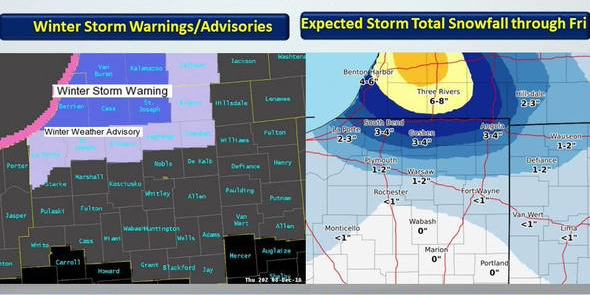

NORTHERN INDIANA — The Indiana Department of Transportation warns that even with pre-treatment, salt and snow plows, white-out conditions are likely to make travel very difficult on Thursday night and Friday in parts of northern Indiana.
A Winter Weather Advisory is in effect for Elkhart, LaGrange, LaPorte, Steuben and St. Joseph counties. Forecasters are calling for bursts of moderate to heavy snow and white-out conditions in areas affected by lake effect snow. A few miles may mean the difference between light snow and several inches of accumulation.
INDOT’s yellow trucks will run their plow routes, treating lanes every 2-3 hours. Continuous snowfall and strong winds, especially in the rural open areas, can make clearing pavement challenging. Plow drivers will continue on alternating 12-hour shifts as long as necessary and resources will be adjusted as needed to keep highways open.
Drivers should expect difficult driving conditions in areas experiencing lake effect snow, and should avoid unnecessary travel, if possible. Motorists who do have to travel are urged to slow down and take their time.
If you see white-out conditions ahead, immediately take your foot off the gas and turn off cruise control, especially on high-speed highways. No one should be traveling at interstate speeds in these conditions. Law enforcement will be writing citations for drivers going faster than conditions merit and putting others in harm’s way.
Additionally, it is important that drivers clear their cars of snow, so they can see – and be seen. Snow blowing off cars can also be a hazard for those driving near them. With INDOT yellow trucks out on state and federal highways, it’s important for drivers to give plows plenty of room to safely do their work.
Other Tips for driving in the snow:
- Stay home if you really don’t have to go out. Even if you can drive well in the snow, not everyone else can. If you don’t have somewhere you have to be, watch the snow from indoors.
- Accelerate and decelerate slowly. Applying the gas slowly to accelerate is the best method for regaining traction and avoiding skids. Don’t try to get moving in a hurry. Take time to slow down for a stoplight. Remember: It takes longer to slow down on icy roads.
- Drive slowly. Everything takes longer on snow-covered roads. Accelerating, stopping, turning – nothing happens as quickly as on dry pavement. Give yourself time to maneuver by driving slowly.
- The normal dry pavement following distance of three to four seconds should be increased to eight to ten seconds. This added margin of safety will provide the longer distance needed if you have to stop.
- Know your brakes. If you have anti-lock brakes (ABS) and need to slow down quickly, press hard on the pedal-it’s normal for the pedal to vibrate a bit when the ABS is activated.
- Don’t stop if you can avoid it. There’s a big difference in the amount of inertia it takes to start moving from a full stop versus how much it takes to get moving while still rolling. If you can slow down enough to keep rolling until a traffic light changes, do it.
- Don’t power up hills. Applying extra gas on snow-covered roads just starts your wheels spinning. Try to get a little inertia going before you reach the hill and let that inertia carry you to the top. As you reach the crest of the hill, reduce your speed and proceed down hill as slowly as possible.
- Don’t stop going up a hill. There’s nothing worse than trying to get moving up a hill on an icy road! Get some inertia going on a flat roadway before you take on the hill.