Kosciusko County
The following individuals were recently booked into the Kosciusko County Jail:
Oct. 31, 2013
Belwinder Singh, 20, 114 S. Scott St., Warsaw, arrested for possession of salvia or synthetic cannabinoid. Bond: $10,000 surety
Jaswant Singh, 55, 114 S. Scott St., Warsaw, arrested for corrupt business influence and dealing in salvia or synthetic cannabinoid. Bond: $5,000 surety
Simranjit Singh, 23, 114 S. Scott St., Warsaw, arrested for possession of salvia or synthetic cannabinoid. Bond: $10,000 surety
Jacob David Rupert, 29, 1752 E. 675 N. Lot 1, Huntington, arrested for two counts of invasion of property. Bond: $25,000 surety
Ashley Marie Ward, 30, 5754 S. Woodland Ln., Warsaw, arrested for corrupt business influence. Bond: $5,000 surety
Christopher William Alley, 28, 5754 S. Woodland Ln., Warsaw, arrested for corrupt business influence. Bond: $5,000 surety
Hannah Rae Eppenbaugh, 18, 412 W. Perry St., Warsaw, arrested for theft under $100,000. Bond: $2,000 surety
Michael Gene Bradley, 51, 2632 E. Evergreen Dr., Warsaw, arrested for failure to comply. Bond: $500 cash
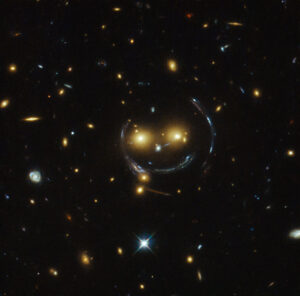
In the centre of this image, taken with the NASA/ESA Hubble Space Telescope, is the galaxy cluster SDSS J1038+4849 — and it seems to be smiling. You can make out its two orange eyes and white button nose. In the case of this “happy face”, the two eyes are very bright galaxies and the misleading smile lines are actually arcs caused by an effect known as strong gravitational lensing. Galaxy clusters are the most massive structures in the Universe and exert such a powerful gravitational pull that they warp the spacetime around them and act as cosmic lenses which can magnify, distort and bend the light behind them. This phenomenon, crucial to many of Hubble’s discoveries, can be explained by Einstein’s theory of general relativity. In this special case of gravitational lensing, a ring — known as an Einstein Ring — is produced from this bending of light, a consequence of the exact and symmetrical alignment of the source, lens and observer and resulting in the ring-like structure we see here. Hubble has provided astronomers with the tools to probe these massive galaxies and model their lensing effects, allowing us to peer further into the early Universe than ever before. This object was studied by Hubble’s Wide Field and Planetary Camera 2 (WFPC2) and Wide Field Camera 3 (WFC3) as part of a survey of strong lenses. A version of this image was entered into the Hubble’s Hidden Treasures image processing competition by contestant Judy Schmidt.
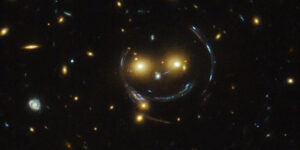
In the centre of this image, taken with the NASA/ESA Hubble Space Telescope, is the galaxy cluster SDSS J1038+4849 — and it seems to be smiling. You can make out its two orange eyes and white button nose. In the case of this “happy face”, the two eyes are very bright galaxies and the misleading smile lines are actually arcs caused by an effect known as strong gravitational lensing. Galaxy clusters are the most massive structures in the Universe and exert such a powerful gravitational pull that they warp the spacetime around them and act as cosmic lenses which can magnify, distort and bend the light behind them. This phenomenon, crucial to many of Hubble’s discoveries, can be explained by Einstein’s theory of general relativity. In this special case of gravitational lensing, a ring — known as an Einstein Ring — is produced from this bending of light, a consequence of the exact and symmetrical alignment of the source, lens and observer and resulting in the ring-like structure we see here. Hubble has provided astronomers with the tools to probe these massive galaxies and model their lensing effects, allowing us to peer further into the early Universe than ever before. This object was studied by Hubble’s Wide Field and Planetary Camera 2 (WFPC2) and Wide Field Camera 3 (WFC3) as part of a survey of strong lenses. A version of this image was entered into the Hubble’s Hidden Treasures image processing competition by contestant Judy Schmidt.