IU Health Goshen: 100 Years Strong, Growing
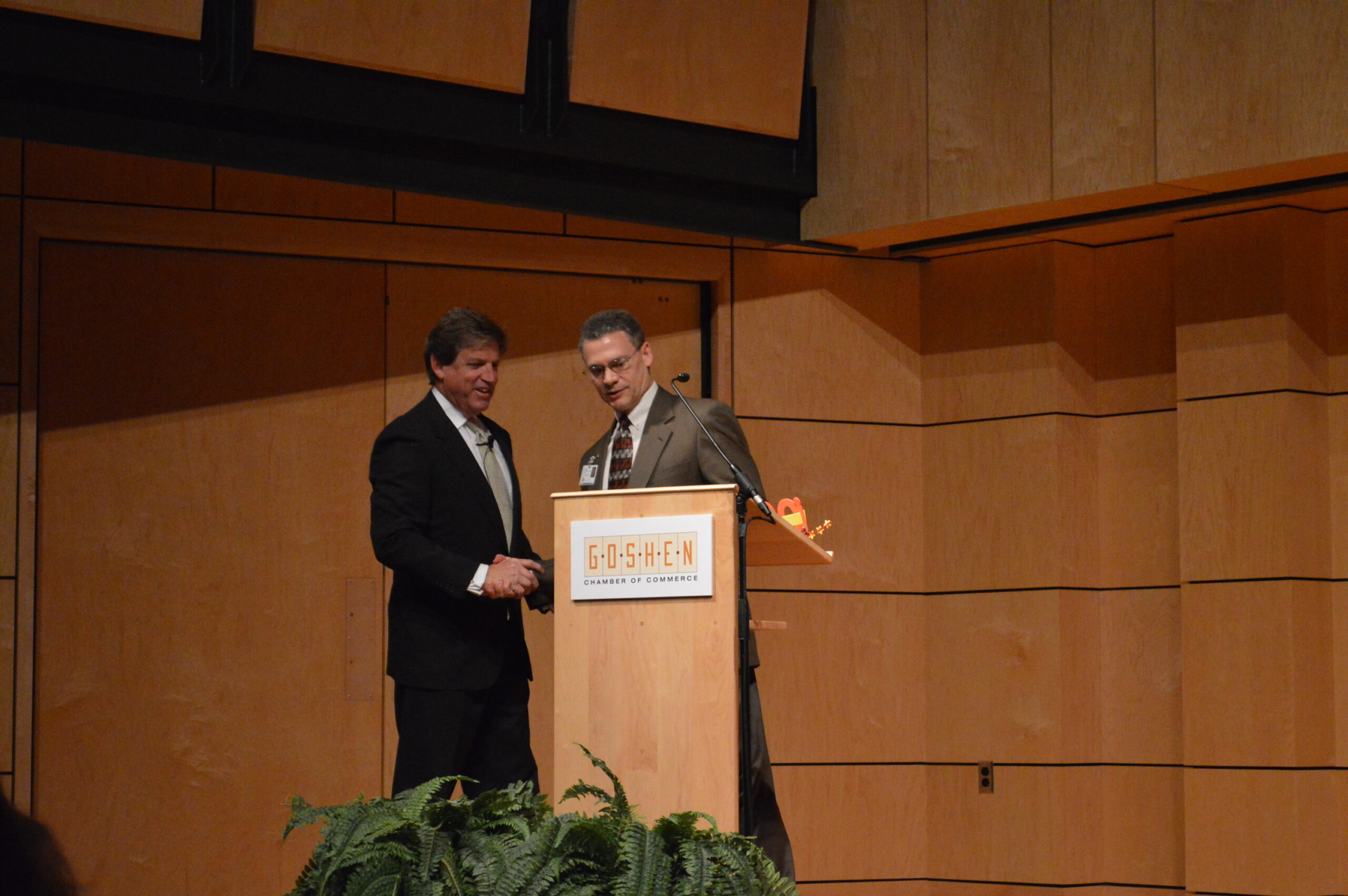

IU Health Goshen Hospital is 100 years old and is important to the community. Will there be another 100 years with the new normal in health care?
Goshen Chamber of Commerce and IU Health Goshen Hospital held a special celebration at Reith Recital Hall, Goshen College, Tuesday with Paul H. Keckley, PH.D, executive director for the Deloitt Center for Health Solutions. The health economist and leading expert on U.S. Health industry trends and reform spoke to approximately 100 chamber members, foundation and auxiliary members and various other affiliates.
“If the community owns true … (and the hospital) successful how it interacts with the community … and evolve on how it manages population health for a successful outcome, I will bet on this community,” commented Keckly.
Keckley briefly noted the 220-year history of hospitals where it was for people who could not afford doctor’s coming to their homes. He pointed out the country went from one hospital to 7,200 hospitals in the 1970s to 5,400 today. “In 10 years we will have about 4,000. In 25 years from now, half that. The reason, some of that, is the natural progression of stuff.”
Today hospitals operate based on 3.1 beds per 1,000 population. In 10 years, he said only 2.5 beds will be needed and in 25 years that number will be reduced again to 1.1. “It is not that people will not be getting sick … but it is a work in progress. The future of hospitals is not a repeat of the past,” he said.
While some industry has recovered from the economic downturn, healthcare is reverse. “By contrast, the downturn in the economy has reduced by 20 percent what people did for themselves, their elective health. So we have a real challenge on our hands.”
Keckley, who has gone through the health reform law 12 times, provided a glimpse of the future. “It’s a very simple answer,” he stated. “We can’t fix the economy unless we spend less on healthcare. Period. End of Story.”
“Health care is 25.5 percent of the budget, as tonight 116 million people are covered by a government insurance program out of 308 (million).” He noted 21 percent of the average state budget is health care, a little more in Indiana. “It’s 19.4 percent of discretionary spending in the average U.S. household, $1 out of $5.”
While the rest of the economy suffered, healthcare done pretty well. Health insurance plans have had record earnings over the last three years and three out of four hospitals have survived, physician income is up 3.4 percent while the household income is down 1.9 percent.
Keckley pointed out that the health care industry does well when the rest of the economy isn’t and the healthcare industry does better when everyone else is doing well. It was noted health care spending has exceeded the gross domestic product, growing 2.5 percent per year for the past 35 years.
“The economy at one point lost 8 million jobs. Healthcare was up 1.4 million jobs. Healthcare is an essential service, but you can’t recruit companies to the county and you can’t get companies to put people on the payroll unless you have strong education and a healthcare system,” Keckley noted. “It’s an arms race in healthcare. Everybody else has to have everybody else’s technology.”
He expects the following from the health reform:
- No more fees for service and paying for results. “Because clearly 30 percent of what we do in this system is unnecessary … hospitals have to lead that process …”
- No more fragmentation in the system and have a system that is fully integrated — doctors, hospitals, long term acute care, hospice, labs, pharmacy, etc. all one team. He noted there are 18 systems within hospitals that each have their own business practices, its own system, its own language, and data that does not cross and causes conflicts. He stated the law pulls things together using a common set of information acceptable to Joe 6-pack at a third grade comprehensive level allowing discussion of risks from all areas before a treatment decision is made. “It’s shared decision instead of physicians making it for us.”
Lastly, Keckley said the reform will put a lid on what is spent where. Using data, it is conceivable all heart work from this area will be done in Cleveland or only five heart procedure locations in the country because of highest outcome at the lowest cost. “It’s really messy getting form here to there. A lot of unintended consequences. We don’t know if a lot of these will work.”
Keckley stated, “We know you cannot sustain Elkhart County healthcare under the old model by simply tweaking. He suggested the public look up population health management. He pointed out an expected $500 billion cut in Medicare is expected to be transformed from a fee for service program to a managed care program, followed by Medicaid.
Keckley was introduced by Randal Christophel, president and chief executive officer if IU Health Goshen Hospital. Christophel touched on key facts of the hospital and its meeting the community needs including providing over $100 million of free care in the past 10 years and providing $2 million to organizations to provide screenings and preventive care and partnerships with 60 businesses to work on employee health.
A joint study with Elkhart General resulted in five key areas needing emphasis and improvement: diabetic management, smoking cessation, access to mental health services, obesity and access to primary care services, a part of future programs and services.